A city with its origins in a Phoenician settlement of the seventh century BC, Caralis comes under Roman control in 238 BC during the Punic Wars. Florus refers to it as urbs urbinum, or capital of Sardinia
At the beginning of the Caere Project the functionality of the encoding model implemented for the Vigna Parrocchiale excavation diaries was verified by conducting a series of searches of the electronic documents using specific key elements. In order to make the documents querying system more flexible and accurate, an Internet application based on the ASP (Active Server Pages) and VBSCRIPT technology has been implemented.
In 1996 the Italian National Research Council (CNR) promoted a Special Project on the Safeguard of Cultural Heritage. Its aim was to foster the protection and exploitation of Italian national cultural patrimony, through knowledge, recording, restoration and conservation.
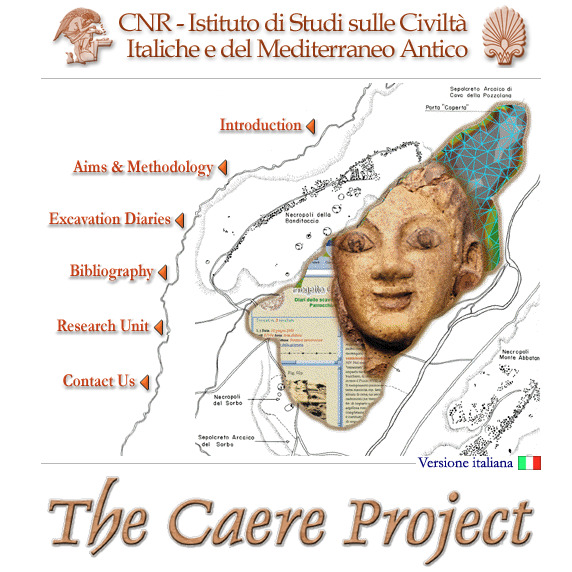
Under this initiative the Istituto per l'Archeologia Etrusco-Italica - at that time directed by Mauro Cristofani (1941-1997) - proposed a research project, which was subsequently approved. The title of the project is "Establishment of an Archaeological Information System model and its application to ancient Caere" (The Caere Project). Its purpose is to use an archaeological information system to study the ancient Etruscan town and territory of Cerveteri, where the Institute has been carrying out surveys and excavations since 1982 jointly with the Soprintendenza per i Beni Archeologici dell'Etruria Meridionale.
The Italian and Albanian Archaeological Project in Butrint is led by Enrico Giorgi (University of Bologna) and Belisa Muka (Albanian Institute of Archaeology), in collaboration with the Butrint National Park and with the support of the Ministry of Foreign Affairs and International Cooperation of the Italian Republic. The Butrint Project was born in 2015 and is part of the wider research agreement on Ancient Chaonia developed in 2000 between the Archaeological Institute of Tirana and the University of Bologna.
Modern Butrint (Butrinti) in Albania, ancient Bouthroton was an ancient Greek and later Roman city located in Epirus. The city became an important bishopric by the sixth century. The site was enrolled as a UNESCO World Heritage Site in 1992 because of its archaeological remains, which date from prehistoric times down through the late Middle Ages.
Un accordo importante, quello tra il CNR ISPC, il Comune di Firenze e la Soprintendenza Archeologia, Belle Arti e Paesaggio per la città metropolitana di Firenze e le province di Pistoia e Prato (SABAP), che da il via ad una collaborazione per la tutela, salvaguardia e valorizzazione degli affreschi di Masaccio, Masolino e Filippino Lippi, considerati uno dei capolavori assoluti del primo Rinascimento fiorentino, che raccontano le storie di San Pietro e impreziosiscono la Cappella Brancacci, risalente al tardo Trecento, custodita nella chiesa del Carmine a Firenze. Il progetto è reso possibile grazie al finanziamento di Friends of Florence e Jay Pritzker Foundation.
Il progetto si articola in due macro-obiettivi tra loro connessi:
→ Brancacci Project Diagnostica (2021-2024)
→ Brancacci VR Project (2021-2023)
Da gennaio 2022, all’interno della Cappella, il Comune di Firenze ha allestito un cantiere con un ponteggio visitabile per consentire ai gruppi di ricerca di effettuare le operazioni necessarie allo studio dello stato di conservazione del ciclo di affreschi. Quello della Cappella Brancacci è un cantiere di diagnostica e monitoraggio unico per competenze e tecnologie, un vero e proprio hub nazionale, coordinato dal CNR ISPC.
L’interdisciplinarietà delle competenze coinvolte, tecniche e umanistiche, permette la comprensione a 360 gradi dell’opera, dalla riscoperta della tecnica esecutiva alla durabilità degli interventi pregressi e futuri, alla staticità della struttura architettonica.
BRAIN is Nature and Culture, Organization and Plasticity. The first network of researchers working in Italian Archaeobotany and an interactive database including archaeological sites with microscopic and macroscopic remains are now available.
Bradypus is an open-source software developed at LAD: Laboratory for Digital Archaeology at Sapienza University of Rome by Julian Bogdani and released under the terms of the GNU AGPL-3.0 License. It is aimed at easily creating, impementing and publishing relational databases on the Web.
Modern Tell/Kawm el-Fara’in, located in Egypt's Nile delta. The site was a locus of human settlement and activity from the prehistoric period through the early Islamic period.
An ancient Egyptian settlement located on the West bank of the Nile to the North of the Second Cataract. During the Old Kingdom Boon or Buhen was the site of a trading colony. During the Twelfth Dynasty, a large fortress was built during the reign of Senusret III.
The Bonn Archaeological Software Package (BASP) is a non-profit software project for and by archaeologists which has been developed cooperatively since 1973. It now includes more than 70 functions for seriation, clustering, correspondance analysis, and mapping tools for archaeologists working with IBM compatible PC's under DOS and all versions of Windows. It also includes programs for three dimensional display of data, for finding rectangular structures in scanned excavation plans containing thousands of postholes, and for the rectification of extremely oblique aerial photographs and their superimposition on large-scale scanned maps under Windows NT/2000/XP/Vista and Windows 95/98/ME.
Volsinii, also referred to as Volsinii Novi, is thought to be the settlement where Rome resettled the survivors of the Volsinian rebellion of 264 BCE. This episode is discussed by Zonaras (8. 7. 8). A late republican center at Bolsena, Italy, with civic architecture (forum) and domus has been excavated since 1946 by the École Française and is identified as Volsinii Novi.
A city of the Po Plain with important cultural phases related to Etruscan, Celtic, and Roman culture. Important evidence for the Iron Age Villanovan culture has been found in Bononia and its vicinity. The Romans established a Latin colony of 3000 settlers at Bononia in 189 BC. After changing hands several times following the fall of the Western Roman Empire, Bologna became an important Medieval center.
Blera was a significant Etruscan settlement in the vicinity of Tarquinii. It lay along the line of the Roman Via Clodia. It received Roman municipal status and was enrolled in the tribus Arnensis. The city flourished in the sixth and fifth centuries BCE.
Come potenziale soluzione alla problematica, il progetto BIMHERIT propone la realizzazione di una piattaforma digitale di condivisione delle competenze, capace di indirizzare i singoli attori coinvolti nel processo verso un metodo di lavoro integrato e sinergico, basato su un lessico digitale comune. Perno fondamentale di questo innovativo paradigma di lavoro è il Building Information Modeling (BIM), un modello parametrico contenente tutte le informazioni che riguardano l’intero ciclo di vita di un’opera. Il caso campione selezionato è il Circo di Massenzio collocato nell’omonimo complesso tra il II e il III miglio della via Appia Antica, a Roma. Tale scelta è dettata dalla sua importanza storico-archeologica, dalla sua complessità monumentale e dal suo grande potenziale a livello turistico.
Il progetto BIM ReCulT si pone l'obiettivo di applicare la metodologia BIM agli edifici monumentali, metodologia definita HBIM, acronimo di Heritage Building Information Modeling, creando una piattaforma appositamente dedicata che supporti tutte le fasi decisionali comprese quelle connesse alla manutenzione, riqualificazione e gestione del bene.