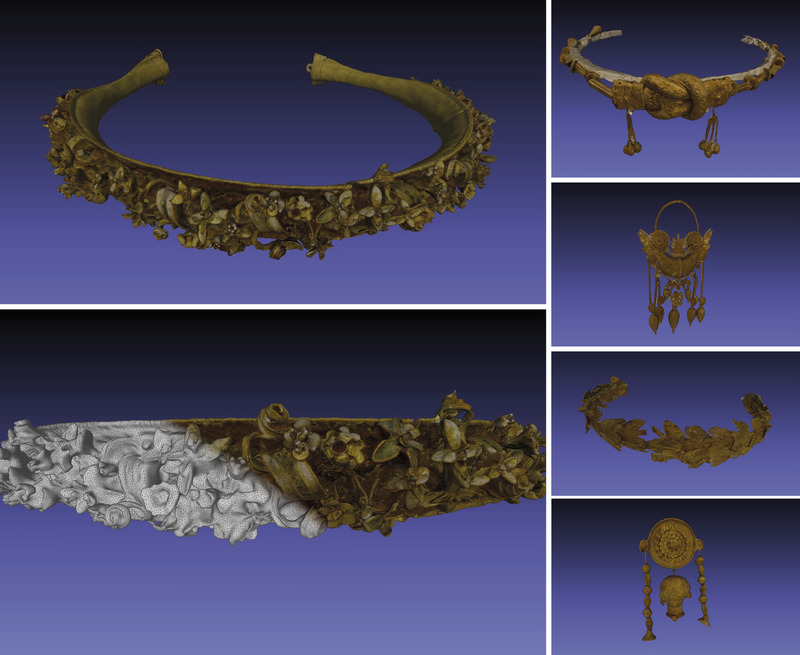
The modern Greek village of Dimini in Thessaly lends its name to important prehistoric and Bronze Age settlements whose remains lie in its vicinity. In the 20th century, some scholars attempted to assign the placename "Aison" (reported by Stephanus of Byzantium) here as well, but others now reject the name entirely as false. The vicinity was abandoned at the end of the thirteenth century BCE and not reoccupied until modern times.
Nell’ultimo decennio e, in particolar modo negli ultimi due anni, caratterizzati dalla pandemia dovuta al COVID che ha reso difficoltoso se non impossibile l’accesso ai siti dei Beni Culturali, si è assistito ad un’accelerazione inverosimile nei processi di digitalizzazione. Il progetto D-TECH (Digital-Twin Environment for Cultural Heritage), si inserisce in questo ambito, ponendosi come primo obiettivo quello di rendere questi dati accessibili e interoperabili da parte dei gestori dei luoghi della cultura, il che ne consente una gestione razionale, oltre che una più ampia fruizione e valorizzazione. In funzione di questo, il progetto è sviluppato attraverso una piattaforma multimediale avanzata dedicata ai gestori dei beni culturali, favorendo, in questo modo, l’offerta di servizi per la condivisione e visualizzazione via web di copie digitali dei beni culturali mobili e immobili.
Survey and creation of a digital replica of the interior of the Tomb of Reliefs located in the Banditaccia Necropolis in Cerveteri (RM). It is the only Etruscan tomb (4th BC) decorated with stucco reliefs, unusual compared to the usual frescoes. The dataset, because of its high resolution and accuracy, is a useful tool for study, restoration planning and enhancement of an environment normally closed to the public for conservation reasons. The dataset was acquired with active (Faro laser scanner) and passive (full-frame SLR) sensors through a spherical photogrammetry campaign. The data were reprocessed by combining Structure from Motion techniques to obtain a photogrammetric solution and Computer Graphic for colour correction (with digital painting tools) and geometry and texture optimization. The data mainly concern the 3D domain, have been reprocessed primarily with open source software and are stored in open formats: photogrammetric solution in utf-8 txt files, point clouds in binary ply, polygon meshes with mapping coordinates in blend format, images in jpeg format. The working group consists of researchers from CNR-ISPC: Enzo d'Annibale, Emanuel Demetrescu, Daniele Ferdani.