

DHeLO and BiDiAr: new digital resources within the H2IOSC Project
- Title
- DHeLO and BiDiAr: new digital resources within the H2IOSC Project
- Creator(s)
- Giacomo MancusoSee all items with this value
- Antonio D'EreditàSee all items with this value
- Date
- 2024
- Is Part Of
-
 Archeologia e Calcolatori
- Volume
- 35
- Issue
- 1
- Pages
- 521–542
- Language
- eng
- Rights
- CC BY-NC-ND 4.0
- Abstract
- This paper explores the initial outcomes of the H2IOSC Project, specifically within Work Package 2 (WP2 - Landscaping & Building Communities), which aims to survey the Italian digital landscape in Language Technologies, Humanities, and Heritage Science (HS). A significant outcome of the efforts of the Rome branch of CNR-ISPC is the development of two key resources: the DHeLO web app and the BiDiAr bibliographic collection. DHeLO (Digital Heritage Landscaping Platform) is designed to collect, store, and query metadata of research projects, products, and digital tools in Cultural Heritage (CH) and Heritage Science (HS). It aims to create a comprehensive disciplinary observatory by integrating data from multiple sources into a structured system that allows for complex queries and data indexing. This platform supports the FAIR principles (Findability, Accessibility, Interoperability, and Reusability) and includes metadata standards based on the Dublin Core Metadata Initiative (DCMI). BiDiAr (Bibliography of Digital Archaeology) functions as a relational database within Zotero, an open-source bibliographic tool. It compiles bibliographic entries relevant to digital archaeology, integrating themes and research outputs from the 'Archeologia e Calcolatori' journal. This database aids in thematic trend analysis and network analysis by linking bibliographic citations, enhancing the understanding of research dynamics and impacts within the E-RIHS community. Analyzing these resources reveals an exponential increase in virtual reality and 3D modeling products, driven by epistemological developments and the disruptive use of photogrammetric modeling. These tools not only enhance data accessibility and usability but also support interdisciplinary collaboration and innovation in digital heritage and archaeology.
- Cites
- Il Geoportale Nazionale per l’Archeologia. Uno strumento per la tutela, la divulgazione e la fruizione del Patrimonio Archeologico italiano
-
 Zotero2Map: sviluppo di un nuovo strumento ITC per la condivisione e la pubblicazione dei dati bibliografici per la ricerca storica e archeologica
- From Field Archaeology to Virtual Reconstruction: A Five Steps Method Using the Extended Matrix
-
 Rilievo, documentazione e ricostruzione di un centro monumentale con fotogrammetria e modellazione tridimensionali: il caso della città romana di Sala
- Archaeological 3D GIS
- Prefazione
- From CHARISMA to IPERION CH and E-RIHS: towards a European research infrastructure for heritage science
- La bibliografia di informatica archeologica nella cultura digitale degli anni Novanta
- From surfaces to volume: towards a volumetric reconstruction of the archaeological deposit
- Towards a virtual archaeology
- tDAR: A Cultural Heritage Archive for Twenty-First-Century Public Outreach, Research, and Resource Management
- L’uso della tecnologia DEM nella documentazione archeologica. Alcune applicazioni in casi di scavo stratigrafico e nello studio dell’edilizia storica
- Digital Infrastructures and their Impact on Data Acquisition
- Cultural heritage on the Semantic Web: The Europeana Data Model
- Archeologia e Calcolatori. Classificazione geografica e tematica per la condivisione della conoscenza
- Developing a digital archaeology classification system using Natural Language Processing and Machine Learning techniques
- "Archeologia e Calcolatori": dieci anni di contributi all'informatica archeologica
- ArchaeoBIM. Theory, processes and digital methodologies for the lost heritage
- Le banche dati archeologiche. Articolazione e formalizzazione delle conoscenze
- Il rilievo fotogrammetrico di Doclea
- From Deposit to Point Cloud – a Study of Low-Cost Computer Vision Approaches for the Straightforward Documentation of Archaeological Excavations
- Molab: a european mobile laboratory enabling advanced studies in archaeometry
- Soluzioni integrate web-based per il Patrimonio Culturale: una prospettiva
- Information Organization and Access in Digital Humanities: TaDiRAH Revised, Formalized and FAIR
- Enacting open science by D4Science
- Digital Archaeology: From Interdisciplinarity to the ‘Fusion’ of Core Competences Towards the Consolidation of New Research Areas
- Virtual Reality in Archaeology
- ArchaeoBIM ed Extended Matrix. Analisi e potenzialità di due processi per l’elaborazione di modelli informativi
- IT applications to archaeology and the OA diamond journals’ challenge. Enhancing access and reuse of textual and visual resources
- The FAIR Guiding Principles for scientific data management and stewardship
- Zotero: A Guide for Librarians, Researchers and Educators
- CulturaItalia: aspetti tecnico-scientifici
- On infrastructure, accountability, and governance in digital archaeology
- Digital Technologies and the Role of Data in Cultural Heritage: The Past, the Present, and the Future
- The ARIADNE Impact
Linked resources
Export
- Media
-
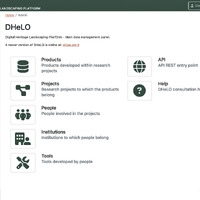
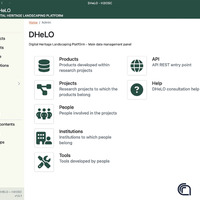 Screenshot of the DHeLO web app home page
 -
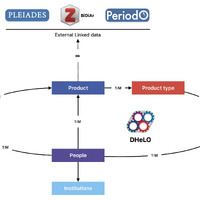 Overview of the DHeLO table schema structure
 -
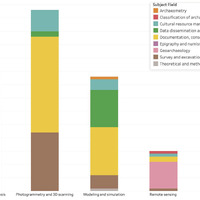 Bar chart of a selection of Products related to the most popular categories of technological applications in the digital CH/HS sectors, colored according to the archaeological research fields primarily concerned
 -
 Map of the Products in the DHeLO database, geotagged through the Pleiades references
 -
 Data types recorded in the DHeLO database thematically grouped and color-coded by category. On the right, within the black box, a selection of the most popular for the CH sector
 -
 Network visualizations of the keywords associated to bibliographic references in BiDiAr. Worth noticing 4 main clusters to explore with further analysis: GIS and cartography (pink), archaeology (blue), photogrammetry (red), excavations (green)
 -
 Graph illustrating the relationships between A&C papers and their correlated records within BiDiAr
 -
 Graph illustrating the distribution over time of the number of publications concerning: Virtual reality and 3D modelling, GIS and cartography and Database
Position: 143 (130 views)