On dit l'" Olympia " de Manet, " La Joconde " de Vinci, ou "Guernica" de Picasso, comme si le lien entre le tableau et son titre allait de soi. Pourtant, identifier l'oeuvre d'art par un titre est une pratique récente. Mais est-ce toujours l'artiste qui nomme sa création ? Par quel processus et à quel moment prend forme l'acte d'intituler une oeuvre ? Quel rôle le titre joue-t-il dans sa création et dans sa réception ? La Fabrique du titre répond pour la première fois à ces questions en portant l'enquête dans les coulisses de la création, du XVIIe siècle à nos jours : intitulés personnels des artistes, titres d'ateliers, intitulations de Salon, musée ou galerie, qualifications de circonstance, dénominations fictives, jusqu'au cas paradoxal des " sans-titre ". Réunissant les meilleurs spécialistes de Courbet, Manet, Gauguin, Rodin, Miro, Masson, Alechinsky, Twombly, Bourgeois et Pane, le livre aborde une multiplicité de genres allant de la peinture aux arts graphiques, de la sculpture à la photographie, de l'action aux performances. Un champ de recherche inédit, fertile en découvertes surprenantes, pour comprendre la genèse de ce geste inaugural : donner à l'oeuvre le nom qui la représentera.
Tra i materiali antichi chemarcano il panorama della città di Pisa, una posizione di rilievo ha il cippo etrusco di via San Martino, noto nell'ambiente cittadino con il nome di "pera", termine che dà nome al vicolo sul cui angolo il monumento è stato posto allo scorcio del XVII secolo. Tuttavia laenzione della "pera" in una cronaca trecentesca, unitamente ad una seconda "pera" posta presso la chiesa di Santo Stefano ultra Auserem, consente di far risalire nel tempo questi reimpieghi, che la tradizione tardo medievale ricollegava alle impresedei pisani nel corso delle prime Crociate.
The purpose of this paper is to describe methods of documentation and detection techniques used on the archaeological site of Mursia (Pantelleria, TP) in order to build three-dimensional models of a hut and a stone mortar. The software measures three-dimensional coordinates of a finite set of points on the object using two photographs taken from different positions (stereo pairs). In particular, we explore some technical aspects of data processing like quickness, measurement accuracy, information content of record and equipments cost.
The article presents the results obtained from the application of two different kinds of software, Photoplan (Kubit) and Image Master (Topcon), to the photographic rectification used as a graphic support methodology for the technological and building analysis of the Provincial Forum of Tarraco. The study of archaeological structures in a modern urban context often imposes limitations and obstacles of a different nature (space, time, financial resources, etc.). In order to overcome such drawbacks, photographic rectification can be used for the bi-dimensional documentation of archaeological structures, as a tool widely affirmed and accepted in a scientific context. Presently there are several different kinds of software available on the market, so that it is difficult to make a choice among the wide range of possibilities. Nonetheless, the advantages and disadvantages of these kinds of software depend mainly on the specific aims and the particular work context. Hence, the choice of Photoplan or Image Master was based mainly on the evaluation of their respective flexibility and speed in both data collection and data processing, considering the size and the location of the structure of interest. For our purposes, the best solution was to alternate the two kinds of software, as they turned out to be quite complementary.
The excavation of the medieval city of Leopoli-Cencelle (Tarquinia, VT) has reached its 24th campaign. The graphic documentation produced over this period faithfully reflects how Information Technologies and instruments for data acquisition have developed in the course of about 20 years. In the case of Leopoli-Cencelle, the main challenge was to produce a modern system of managing and using data and to subsume all the paper elements into one functional and searchable digital format.
Nell’ambito delle società a economia produttiva della preistoria recente, l’organizzazione delle attività di produzione e consumo all’interno degli spazi insediamentali è elemento strutturale rispondente all’articolazione e agli equilibri tra individui o gruppi di individui. Il relativo studio è dunque cruciale per la comprensione dei processi di diversificazione intracomunitaria e poi affermazione delle disuguaglianze. La ricerca esposta in questo lavoro ha avuto al centro questa sfida scientifica e l’ha affrontata attraverso un approccio interdisciplinare e una lettura contestuale, in chiave funzionale e della distribuzione spaziale, dei manufatti e dei resti bioarcheologici provenienti da uno dei contesti dell’età del Bronzo più importanti del Mediterraneo centrale nel quadro del II millennio a.C.: l’insediamento fortificato di Coppa Nevigata.
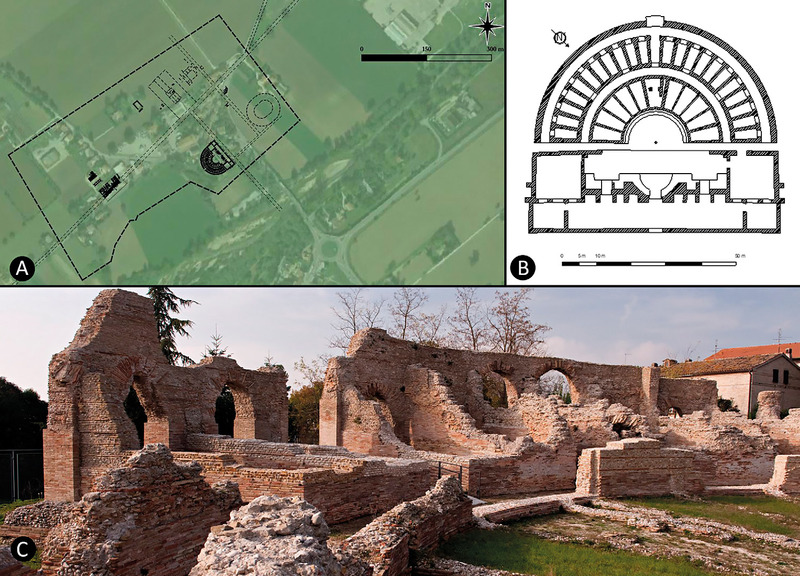
This paper presents a workflow developed thanks to the collaboration between archae- ologists and engineers, aimed at the documentation, representation and virtual fruition of an archaeological site. The purpose is to exploit the data acquired through digital solutions and the consequent elaboration of a reality 3D model to support archaeological studies and to effectively disseminate their results. The presented case study is the Roman Theatre of Ricina (Villa Potenza, MC). The building has preserved much of its masonry, but it is very different from that which could be appreciated by the audience of theatrical performances in Roman times. The work has been developed according to three steps: 1) digital documentation of the site and elaboration of a reality-based 3D model; 2) study of the archaeological finds thanks to the reality-based 3D model and design of a possible reconstruction, represented through a second 3D model elaborated by anastylosis; 3) development of a Virtual Reality environment for the fruition and the interaction with the two 3D models. The final output is therefore an immersive VR application that offers the possibility to access to the theatre both in its current form and in the original one. An experience that is not limited to a simple visualization rather presenting itself as a guided tour across the centuries.
The article illustrates the main research lines promoted at a national level by Law n. 113/1991, as amended by Law 6/2000, for the dissemination of the scientific culture and the active support and participation of the Accademia Nazionale dei Lincei. As part of this initiative, the main CNR-ISMA projects approved and funded by Ministry of Education, University and Research are then described, including, in particular, the two projects ‘20 years of Archeologia e Calcolatori’ and ‘The Virtual Museum of Archaeological Computing’. They both are intended to offer open access resources for documenting and disseminating archaeological research data.
Our research analyses the potentialities and critical aspects resulting from the integration of BIM systems in the processes of survey, communication and management of the Built Cultural Heritage (BCH). It deals with the conceptual extension of “virtual model” triggered by BIM approach and its possibilities of stratifying knowledge. The potential of BCH-oriented BIM systems (the so-called Historical-BIM or H-BIM) is undeniable. However, there remain operational and theoretical issues related to the unresolved aporia beteen te rigiity o moelling tools an te ig leibility needed when BCH elements are involved. Supported by some test applications carried out on case studies belonging to Sapiena main camps, or researc aime at eining a comprehensive approach for the implementation of BIM in the consolidated processes of survey, mainly referring to massive capturing technologies. In the transition from the numeric model (point cloud) to the geometric one (synthetic and structured at semantic level too) this paper discusses the introduction of a new parameter, the Level of Reliability (LOR). This new factor intends to measure and explain the consistency of digital objects resulting from critical analysis and re-elaboration activities. Current vagueness of standards together with the need for transparency in H-BIM modelling processes has led to the LOR as a possible solution to preserve the geometric correspondence and the ontological reliability of the model vis-à-vis the artefact it intends to represent. It describes, in fact, the level of global coherence of te process eining eac element o te moel an te moel as a whole. The coding of a set of common and shared parameters maes it possible, inally, to aciee a syntetic nmeric ealation of the LOR, a sort of “score” for the model. In this framework, the Level of Reliability may perhaps represent a relevant methodological step forward to “customize” BIM syted approaches that imply the gradual and deep knowledge of artefacts as a precondition for their conservation and enhancement.stems in order to make them more compatible with BCH issues. In other words, to encourage, support and implement the consolida
The domus de janas are the typical rock-cut tombs of Sardinian Late Prehistory. Many of them are decorated. Motifs are made with different techniques: painting, sculpture and incision. Architectural elements, busts, cattle and sheep, and horn-shaped features are represented. Painting is generally used to decorate the ceilings, the jambs of doors, walls and false doors. The difficulty of detecting traces of paint complicates the identification of the ancient use of this decorative technique. The aim of this work is to describe the great utility of the plugin DStretch, extension of the ImageJ software, as a method of computer analysis and processing of multispectral images on the paint traces at the sides of the Perdonighéddu domus de janas (Sorgono, NU, Sardinia, Italy). This system opens up new perspectives in the study of the paintings found in the domus de janas, by allowing a crisper image of the decoration, through an alteration of digital photography chromatic scale. The analysis of the images of this grave reveals the presence of traces of painting that decorate the sides of the entrance by forming two doorposts supporting the lintel.
La Dacia, antica regione che comprendeva i territori dell'odierna Romania, ha visto fiorire nei secoli precedenti all'espansione romana una cultura ricchissima, che ha raggiunto una delle sue migliori espressioni nell'arte orafa. Centoquaranta oggetti in oro e in argento, provenienti in gran parte dal Museo Nazionale di Storia a Bucarest e per la maggior parte inediti, vengono presentati al pubblico italiano in una grande mostra accompagnata da questo catalogo. Corredi tombali, monete, armi, vasellame prezioso e soprattutto gioielli - fra cui spiccano i quattro bracciali spiraliformi che, trafugati dal tesoro nazionale rumeno, sono stati recentemente recuperati sul mercato antiquario - raccontano di questa fiera popolazione barbarica, sottomessa a Roma dall'imperatore Traiano. I reperti, che coprono un ampio arco cronologico che va dall'Età del Bronzo (XVII secolo a. C.) al periodo bizantino (V-VI secolo) testimoniano l'altissimo livello qualitativo raggiunto dai Daci nella lavorazione dell'oro, in cui il linguaggio autoctono si mescola alla rielaborazione di elementi derivati dalle cultura greca e romana con cui nel tempo essi vennero a contatto.
The author describes the recent set up of the Archaeological Museum Santi Furnari at Tripi (ME), inaugurated in 2012, and considers it as an example of technological innovation focused on the regional territory. Thanks to the application of digital technologies during the visit, the quality and value of the archaeological exhibition has improved considerably. Recently, to complete the path of modernization, the virtual tour experience of the Museum has also been added on the web platform (http://goo.gl/maps/hqNw4). This window of innovation has stimulated a considerable increase in the number of visits which, at present, amounts to around two thousand people a year.
This article is intended as a review of the contact points between information technologies and cultural heritage, starting from the classification and cataloguing methods applied both to scientific and historical research. The Author describes the aims, activities and results obtained by the Archaeological Superintendencies in Campania from the most important projects developed between 1987 and 2010. In these projects, thanks to the cooperation with private and other public institutions involved in ICT, specific patterns and models of cataloguing and territorial information systems were created related to the domain of cultural heritage, including databases and information retrieval, GIS and CMS applied to cataloguing objects and settlements, web sites and cooperative and distributed web systems for cultural contents dissemination. The Author analyses the various methods and purposes of the applications conducted for studying, safeguarding and promoting the historical and archaeological heritage, in order to define the phases of this technological development and outline the mutual influences and benefits for these different but increasingly interconnected fields of research.
The use of multimedia to study history and archaeology is the principle of the application created by a Parthenopean IT company, the Ceaprelda srl, with the collaboration of a group of archaeologists coordinated by the author. The fusion between specialist competence and technology has allowed us to create a unique multimedia product, that can claim of being the first on floppy disk with archaeological and artistic emphasis. On the computer video it is possible to navigate the real and exact itinerary through territories, archaeological places, towns of particular historical-artistical interest or in the halls of museums. In every page of text a series of “windows” can be opened showing with monographic index-cards, curiosities and historical information, accompanied by photographs. The software is able to simultaneously process a high amount of information (texts, photos, graphic elements and sound) in an interactive form using the Windows operating system. Through applying a generic level of global authoring, the same project model always appears according to the specific requirements dictated by the contents; to design the program structure the Hypermedia Design Model (HDM) was considered, though this model refers generally to a hypermedia context. The project model has therefore allowed for the creation of a multimedia product, that led to the production of two titles: “Campi Flegrei” and “Napoli Mirabilia”. The structure of the text is based on a series of “entities”, to be considered as wide thematical classifications (e.g. contexts, itineraries, cards), each one formed of “components”, connected to it by contents and pattern. The reading scheme, with textual (descriptive pages) and visual (photos present on each page) information, is structured on the series of applied “links” that consent the admission to the various entities: moreover through an infinite series of logical and detailed paths (web), transversal readings of contents can be obtained. It is also possible “to navigate” in the text with the help of topographic maps. Using the “Print” function the various itineraries can be transformed into a little guide-book, while the “Search” key allows for a specific word search in the text, for a faster and more refined consultation. The series of technological innovations has allowed us to “simulate” the conditions of real visits. Other itineraries have also been created in the same manner. In particular, these are for the Southern Etruria (A. Naso, with an introduction by M. Cristofani) and Paestum (E. Greco and I. D'Ambrosio). This particular method of management and research has been used for purely educational purposes, but the software can be adapted to become an instrument for scientific research.
Este trabajo pretende investigar el tratamiento que se da a la Prehistoria en la red social Twitter. Para ello, se han analizado los mensajes que, durante el periodo de un año, contienen el hashtag #prehistory, junto con sus posibles variantes. De este modo, se ha podido acceder al contenido de los mismos, identificar quiénes son los autores más activos e influyentes, analizar su centralidad dentro de la red y detectar las comunidades implícitas a la misma. Se evidencia, entre otras cosas, una escasa presencia en la red de personas e instituciones con autoridad en la materia, la existencia de mitos cronificados en muchos de los discursos y un desigual tratamiento de los diferentes estadios culturales en favor de la Edad del Bronce.
Through the participatory archaeology project “Archivio di Comunità del Monte Baldo” (led by the Chair of Medieval Archaeology of the University of Padua), the foundations have been laid for the creation of a digital archive that catalogues and enhances the aspects of cultural richness of the Monte Baldo chain. Preliminary research, resulting from the synergy between the University of Padua team and the community of Brentonico, has revealed how the mountain huts are perceived as one of the defining features of the local landscape. In response to this popular interest, a more in-depth study on this topic has been undertaken, encompassing its landscape, architectural, environmental, and infrastructural aspects. In particular, a systematic census of the alpine structures (or their residual traces) has been initiated, and the results have been compiled into a catalogue of mountain hut architectures. Based on the collected data, it has been possible to contextualize the surveyed structures within a historical territorial framework.
Francesco Gnecchi was one of the most important Roman coin collectors between the XIX and XX Century. His collection, consisting of about 20,000 pieces, was purchased in 1923 without any related document. In 1933 the epistular archive owned by one of the Gnecchi heires was found. The study of the archive allows us to have important information concerning the purchase of pieces and, consequently, their origin. To make possible a systematic analysis, the archive has been stored with a scanner on a computer system and an appropriate retrieval program has been developed.
Dans lapproche des uvres littéraires, la critique a toujours eu tendance à privilégier limaginaire visuel. Mais les textes du Moyen Age, outre quils relèvent originairement de loreille et de la performance, mettent aussi en scène des phénomènes sonores variés, du cri au cliquetis, de la parole à la musique. Ces événements ne sont pas anecdotiques ; ils forment un réseau et constituent un paysage contrasté. Dun genre à lautre, dune uvre à lautre, lambiance sonore varie : la criée épique forme un cadre acoustique bien différent du concert des oiseaux qui ouvre la chanson damour et si certaines chansons de geste sont de véritables symphonies, dautres jouent sur une ascèse. Cest cette poétique du sonore quil convient de mettre au jour au terme dun parcours non restrictif à travers les littératures latine et surtout vernaculaires du Moyen Age. Cest la partition que dessine chaque texte, la Chanson de Roland comme le Conte du Graal, lInferno comme les Canterbury Tales, que nous nous proposons dexplorer et dinterpréter.
Within the chapter on the organization and resources of the city of a book on Thasos, presentation of the resources of the underground of the island. The pottery clay resources are rather modest, but gave rise to an important production of vases, and in particular commercial amphoras for the famous Thasian wine. Marble is a much more important resource: exploited since the arrival of the settlers from Paros, it was exported to more and more distant destinations until the protobyzantine period. Polymetallic minerals (gold, silver-lead, copper, iron) gave rise to the early development of metallurgical techniques, which were largely responsible for the island's prosperity during the Iron Age and the Archaic Period.
In questo lavoro si cercherà di fornire una prima visione d’insieme sulla circolazione del denaro lucchese a nord dell’Appennino tosco-emiliano sulla base delle analisi di fonti scritte e materiali. Durante l’XI secolo, le varie zecche imperiali iniziarono a coniare monete con contenuto d’intrinseco assai diverso, facendo nascere le cosiddette “aree monetarie”. Analizzando documenti editi, e scavi archeologici noti, si cercherà di fare il punto sulla penetrazione del lucchese in Emilia-Romagna e sulla nascita della grande area monetaria in questa zona geografica. Questo studio, pur se da considerarsi preliminare, rispetto a ricerche più approfondite che i due autori stanno conducendo sull’argomento, si spera possa essere la base per una nuova riflessione su questa tematica, che negli ultimi anni sta riscontrando sempre più interesse tra gli studiosi.
Despite the impressiveness of its remains, until 2008 the city walls of Hierapolis of Phrygia (4th century AD) were one of the lesser known monuments of the city. The preserved and reconstructed remains of the fortifications are about 2.1 km long and are characterized by the systematic reuse of many blocks and architectural materials from necropolises and monuments that were demolished at the time of the construction of the walls. The study and the topographical survey (using a differential GPS) of the city walls were employed along with the analysis and centimetric positioning of all the main reused architectural elements (1142 items), i.e. those which are easier to recognize and to trace back to the buildings from which they came. The fieldwork was carried out using a Tablet PC and a specially developed computer schedule to record the characteristics of the recycled materials and their location. The data were uploaded into a dedicated and specially developed geodatabase, aimed at managing information related to the heterogeneous materials reused, integrating the intrinsic characteristics of objects and their positions. In the geodatabase, every architectural element was catalogued so that spatial queries could be made to identify the existence of homogeneous materials and determine their positions along the walls; they are also correlated with their monuments of origin when this information is available.
The digital transition of the AEC sector is a requirement for all professionals involved in, for this reason the topic of Representation strengthens the centrality of its role related to different involved field, thanks to data interoperability. BIM is the methodology that enables the sharing of graphical and alphanumerical information among different professionals. The developed methodology fitted during these years is described for several projects, and it is always composed by three phases: survey and documental research; digital modelling and data interpretation; data exploitation through interoperability. BIM process still does not reach an optimized interoperability level, but this represent the added value of technological innovation for construction industry, as a tool for information sharing.
In 1998 the Museums Service of the Lazio Region began a project to set up a database for the archaeological finds ('RA' files) preserved in the museums of this area. The intention was to provide a simple means for locating and quantifying the finds preserved in each museum for the use of museum directors, regional offices and any external users. A management software programme - IDRA, developed by the firm Andromeda - was chosen with this in mind. Data structuring and normalisation methods to reach the necessary level of standardisation were defined during a series of meetings between archaeologists. These meetings produced a proposal for regulations in addition to those drawn up by ICCD in 1992, also including a section devoted to faunal remains from archaeological sites. The software was configured, with suitable adaptation and integration, on the basis of the specific requirements that emerged during the work. It was also designed to combine scientific correctness, data normalisation and compliance with national cataloguing rules, as well as being a functional and easy-to-use application. IDRA is designed as a client/server system with an SQL engine. As regards the database organisation, the system combines the philosophy of relational databases with object-oriented structures, in which the information is organised hierarchically. This enables data to be associated logically and permits the description of complex structures, such as those relative to the archaeological objects in question. Since it was felt that the use of a 'stand-alone' software would render much of the efforts towards the normalisation and definition of terminology lists useless, a databank sharing system will be introduced, with centralised 'management' in regional offices and diverse access levels for users. Today the database consists of about 10,000 files for 27 museums, soon to be completed with the relevant digital images. An assessment of this initial stage is currently a priority, also by means of comparison with other databases for a more accurate and selective compilation of terminology lists, while another priority is the experimentation of network connections for database sharing with each individual museum.
In 1999 the Museum Service of the Lazio Region, together with the firm Andromeda, set up a database for the archaeological finds in the municipal museums in the region. The project, called IDRA, was created for the purpose of locating and quantifying the archaeological material in each museum. Designed as a client/server system with an SQL engine, IDRA software combines the philosophy of relational databases with object-oriented structures, where the information is organized hierarchically. At this time the database consists of around 17,000 files - provided with digital images and referring to 50 different museums - that are now available on the Culture Portal of the Lazio Region (http://www.culturalazio.it/site/it-IT/Argomenti/Banche_dati_online/). A tentative model used to locate both museums and finding sites through Google Maps has also been made. On the basis of specific agreements with the Ministry of Culture and the Municipality of Rome a project was initiated for a shared consultation of databases pertinent to different authorities as well as for a common investigation about structured terminology lists. To this aim we have conducted a standardization of terminology related to the entry “Object Definition”, and developed a list of about 500 terms. In the present article we have focused on some of the issues that emerged during our work in order to submit them to public discussion. We deal, for instance, with how to define the state of preservation of the object in relation to its definition; whether and how to use diminutives; how to structure the categories of material so as to define the finds for optimal searching; and how to file objects reused at a later period.
The article presents a brief description of the principal institutions which, during the 1970s and 1980s, were in charge of the computer cataloguing of their respective national cultural heritages, with specific emphasis on archaeological heritage. Particular attention is dedicated to the Italian experience, with some reference to the situation in England and in France during the same period. The 1970s and 1980s are, in fact, two particularly remarkable decades, in which centralised national projects followed the first isolated experimentations, and developed tools, such as lexicons and thesauri, as well as techniques for indexing and information retrieval. The article focuses in particular on the activity conducted in Italy by the Istituto Centrale per il Catalogo e la Documentazione (ICCD), as well as that of the Scuola Normale Superiore in Pisa. As far as England is concerned, the author describes the pioneer research work of the Royal Commission on the Historical Monuments of England (RCHME), founded in 1908, and, more recently, that of the Archaeology Data Service (ADS); for France, the author focuses on the work conducted since 1964 by the Inventaire général des monuments et richesses artistiques de la France.
The author explains the principles applied by the Istituto Centrale per il Catalogo e la Documentazione for the automatic processing of archaeological data in connection with the tasks of protection and preservation of the national cultural heritage. These principles aim at characterizing each archaeological work and at determining the relationships between these and their territorial context in a global historical dimension. Recent research works, and in particular those (generally disappointing) undertaken in the context of the so called “Giacimenti Culturali”, pointed out the necessity of a conceptual, more than technological, coordination. For this reason some fundamental methodological tools were implemented: “Dizionari Terminologici”, “Strutturazioni dei dati” and photographic inventories published by the Institute.
Il progetto Miranduolo nasce alla fine degli anni '90 del XX secolo quando, con la redazione della Carta Archeologica della Provincia di Siena, fu sottoposto a ricognizione il territorio comunale di Chiusdino.
The Karnak Cachette, excavated by Georges Legrain between 1903 and 1907, is one of the most fascinating discoveries of Egyptian archaeology. The first reason lies in the very high number of objects found in it (statues, stelae, furniture of various
La Bottega del Pittore di Meleagro è forse quella che offre gli spunti più significativi per uno studio dei cambiamenti che avvengono negli anni tra la fine del V e gli inizi del IV secolo a.C. nell'ambito dell'organizzazione della produzione ceramografica attica. Già il Beazley, nella prima edizione della sua opera e per primo, aveva riconosciuto l'importanza e l'omogeneità di un gruppo di 47 vasi che aveva raccolto, avvicinando a questi...
A trent’anni dalla fondazione della rivista «Archeologia e Calcolatori», si è pensato di avviare, all’interno della collana Futuro Anteriore, una nuova serie editoriale dal titolo “30 anni di informatica archeologica” per ripercorrere alcune tappe che hanno segnato il cammino di un’attività di studio e di diffusione dei risultati della ricerca scientifica in un settore caratterizzato dall’interdisciplinarità. Il primo volume è dedicato all’esame critico della Bibliografia di informatica archeologica, pubblicata sotto forma di rassegna in calce ai primi dieci numeri della rivista e oggi aggiornata e consultabile in rete nel Virtual Museum of Archaeological Computing. Un’analisi retrospettiva, ma anche prospettica, ha così costituito lo spunto per descrivere il panorama culturale internazionale degli anni Novanta, collegandolo alle conquiste dei decenni precedenti e parimenti alle sfide degli anni a seguire, che hanno orientato il corso dell’archeologia digitale del nuovo Millennio.
Recent research work, carried out as part of the international project on 'The History of Archaeological Computing', jointly promoted by the Italian National Research Council and the Accademia Nazionale dei Lincei, has created the premises by which to publish online the database of the Bibliography of Archaeological Computing. The database was regularly implemented during the first ten years of publication of the international scholarly journal 'Archeologia e Calcolatori' (1990-1999), and covers a period ranging from 1989 to 2000. The dataset was revised and made available online in the 'Virtual Museum of Archaeological Computing', featuring more than 2,700 titles. Data structuring and updating led us to re-appreciate the analysis of the results, published for the first time in the tenth issue of the journal, by also linking the period under investigation with the achievements of the previous decades and anticipating the challenges of the years to come. This article sets out both the research work now being carried out to classify bibliographical information and the results obtained from the statistical analysis of the dataset.
ItIl rapido sviluppo delle ICT e la crescente disponibilità di strumentazioni e software anche a basso costo ha consentito, ad una vasta piattaforma di utenti, di sperimentare le potenzialità offerte dalle tecnologie digitali a servizio del Patrimonio Culturale. La conseguente grande diffusione di rappresentazioni digitali ha portato, dopo un lungo percorso, nel 2009, alla stesura della “Carta di Londra” che ha l’obiettivo di stabilire dei principi metodologici generali per le applicazioni di visualizzazione digitale nel settore della ricerca e della comunicazione dei Beni Culturali. I “Principi di Siviglia” rappresentano una implementazione della Carta di Londra, specificamente riferita al campo dell’archeologia. L’esperienza condotta può rappresentare un interessante riferimento per il campo dell’architettura, per il quale, tuttavia, sembrano necessarie alcune riflessioni di ordine disciplinare e metodologico. Pertanto il contributo vuole offrirsi come base di riflessione sulla possibilità di declinare i principi della “Carta di Londra” al settore dell’architettura storica e, più in generale, sulle problematiche ed opportunità offerte dalle tecnologie e strumentazioni digitali nel rilievo, visualizzazione e rappresentazione dei Beni Architettonici.EnThe rapid development of ICT and the increasing availability of low cost tools and software for a wide platform of users have favored the studying of the possibilities given by digital technologies applied to Cultural Heritage. The consequent widespread use of digital representations of Cultural Heritage led in 2009, after a long process , the drafting of “The London Charter" which aims to establish general methodological principles for digital visualization in the research and communication field of Cultural Heritage. The “Principles of Seville” represent an implementation of the London Charter, specifically related to archaeology. The gained experience should be an interesting reference for the architectural field, for which, however, it seems necessary some disciplinary and methodological considerations. Therefore the paper want to be a base point to develop a consideration on the opportunity to decline the principles of “The London Charter” in the architectural heritage field and, more generally, on the issues and opportunities offered by advanced digital technologies and tools for architectural heritage surveying, visualization and representation.
In questo contributo si focalizza l’attenzione sulla ricostruzione grafica e virtuale del patrimonio e sulle sensazioni che la ricostruzione evoca nel fruitore del messaggio culturale. La ricostruzione si attua mediante la collaborazione tra archeologo e illustratore e costituisce un momento di verifica visiva dell’interpretazione archeologica e uno strumento di comunicazione del dato archeologico fruibile a più livelli. Ciò avviene grazie allo scambio costante di informazioni (dati scientifici e proposte di ricostruzione) e il confronto che ne deriva determina i metodi e le fasi di avanzamento del progetto. Il metodo si basa sull’integrazione delle immagini 3D con il disegno tradizionale ed è finalizzato alla trasposizione del dato archeologico, in modo tale da garantire alla ricostruzione il duplice requisito di soddisfazione estetica e credibilità scientifica.
This paper describes a procedure of archaeological interpretation and representation based on DEM technology. Through different contexts of application the aim is to describe the potential of this procedure, useful for recreating all the stratigraphic complexity of an archaeological site. After an introduction and a short history of studies about the use of DEM in archaeological documentation, the Author illustrates two examples of archaeological excavation and two of archaeology of architecture. The first case study is the Castle of Castelpizigolo (Toano, RE): the DEM documentation was used for the production of automatic profile lines of every archaeological stratification. A similar result was obtained in the documentation of the second archaeological context, the site of Capo Don (Riva Ligure, IM). The subject of this investigation was a fireplace dating from Late Antiquity to the early medieval period. The second part was focused on the use of DEM in the archaeological analysis of buildings. A preliminary investigation was focused on an example of household architecture from the island of Rab (Croatia). The DEM was used for the interpretation of the origins of some architectural instabilities, caused by stratigraphic changes which occurred in the original building. The last case study was the rural church of S. Giusto in Marlia (LU), where DEM analysis gave a new interpretation about the archaeological evolution of this building. The procedure described in this paper is an innovative method for producing a faster and more accurate archaeological documentation and for giving a new archaeological tool for the stratigraphic interpretation of historical buildings.
Cette introduction à Inactualité de l’ornement est une tentative de comprendre dans la longue durée pourquoi, en Europe, l’ornement a été problématisé de manière morale, et pourquoi, depuis la seconde moitié du XIXe siècle environ, il a fait l’objet de critiques sans précédent. L’article cherche d’abord dans les sources philosophiques et chrétiennes de la théorie européenne de l’ornement la constitution d’une éthique du décor. Puis il se focalise sur le passage, aux XIXe-XXe siècles, à une moralisation de l’ornement qui l’exclut du domaine de l’art. Enfin, il s’interroge, à partir du post-modernisme, sur les fonctions positives de l’ornement dans le monde contemporain.
The project involves the setting up of a virtual tour for the Museum of the Origins, namely the Museum of Prehistory and Protohistory at the Sapienza University of Rome Museum Pole. The virtual tour has been developed through open source technologies: a low-cost approach was pursued to provide a work-flow example for other museum sites wishing to acquire this promotion tool. The final product was designed both for museum use (in-site) and for a web spread (web-site).
Le Cours d’archéologie, professé par M. Raoul-Rochette à la Bibliothèque du Roi, tous les mardis, édité à Paris en 1828, est le plus ancien exemple français d’un cours d’archéologie publié. La fonction de conservateur du Cabinet des antiques et médailles s’accompagnait en effet d’une charge de divulgation à travers un enseignement régulier, sur place, illustré au moyen des œuvres et des livres possédés par le Cabinet. Nous avons choisi d’étudier ces débuts de l’enseignement de l’histoire de l’art et de l’archéologie classique en France à travers la partie de son cours consacré à l’art étrusque, un domaine que Raoul-Rochette affectionna tout au long de sa carrière, comme en rendent compte ses travaux, sa collection personnelle d’art ou encore ses voyages. Le premier intérêt de ces leçons publiées est de nous donner l’état des connaissances sur l’archéologie étrusque de l’époque, en évoquant les débats historiographiques en jeu ainsi que l’actualité des découvertes archéologiques ; elles permettent en deuxième lieu d’apprécier le rôle accordé alors à la civilisation étrusque aux regards de celle des Grecs, montrant ainsi l’orientation qu’ont prise les travaux sur l’étruscologie, et particulièrement dans la recherche française ; elles montrent enfin la composition tout à fait significative d’une collection d’art étrusque dans la France du début du xixe siècle et la manière dont elle est expliquée au public cultivé qui assistait aux cours de la Bibliothèque royale.
Over the past few decades an intense discussion has taken place among scholars about the important role that instrumentum inscriptum plays in the reconstruction of various aspects of Roman social and economic history. One of the key issues is the definition of the criteria for publication and digital cataloguing of this class of materials, which includes various types of objects (amphorae, lamps, fine ware pottery, building materials, etc.) and inscriptions (stamps, tituli picti, graffiti ante or post cocturam). This paper presents a proposal for cataloguing fictile instrumentum inscriptum through a relational database which takes into account both the archaeological and epigraphical aspects of this kind of documents, while also paying particular attention to possible prosopographical comparisons with lapidary epigraphy. The collection of these data allows the user to pursue socio-economic research on the basis of different criteria, which can be variously combined: geographical, typological, prosopographical and chronological. Three case studies proved the effectiveness of this tool both for analytical and statistical studies.