

3D-STONE: a comprehensive workflow for structured light scanning and digital twin modeling of stone architectural elements in archaeology
- Title
- 3D-STONE: a comprehensive workflow for structured light scanning and digital twin modeling of stone architectural elements in archaeology
- Creator(s)
- Sara BozzaSee all items with this value
- Date
- 2025
- Is Part Of
-
 Archeologia e Calcolatori
- Volume
- 36
- Issue
- 1
- Pages
- 277-304
- Language
- eng
- Abstract
- The paper outlines the state of the art in structured light scanning (SLS) in archaeology and highlights the potential of 3D imaging technologies for documenting architectural elements. It introduces the 3D-STONE workflow, a comprehensive methodology for the structured light scanning and 3D modeling of stone architectural elements, developed and tested as part of the CHANGES project (CNR-ISPC). Experimentation was conducted using the Artec Eva scanner on marble blocks from the Basilica Iulia in the Roman Forum (Rome) and the Monumental Nymphaeum of Tripolis ad Maeandrum (Denizli, Türkiye), addressing both archaeological and technical-practical challenges. The workflow covers all stages, from fieldwork to the creation of high-resolution digital replicas, offering an efficient, reliable process specifically tailored to architectural blocks. Results demonstrate that SLS technology provides unparalleled accuracy in capturing geometry and texture, while significantly reducing field and processing times. This establishes it as a highly valuable tool compared to photogrammetry-based approaches to produce digital replicas of blocks, suitable for virtual reconstructions, morphological analyses, conservation mapping, and for enhancing public engagement with monuments
- References
- Tripolis ad Maeandrum, Monumental Nymphaeum: 3D model of Corinthian pilaster capital no. Tr18AÇ20
- Rome, Basilica Iulia: 3D model of Ionic cornice no. 409024
- Zotero References Collection
- https://www.zotero.org/groups/5293298/bidiar/collections/SHZWMG6A
- Cites
- Establishing Best Practices for Photogrammetric Recording During Archaeological Fieldwork
- A Simple Photogrammetry Rig for the Reliable Creation of 3D Artifact Models in the Field: Lithic Examples from the Early Upper Paleolithic Sequence of Les Cottés (France)
- Closing the seams: resolving frequently encountered issues in photogrammetric modelling
- The Digital Revolution to Come: Photogrammetry in Archaeological Practice
-
 Data extraction from 3D scanning: post-processing filtering for analytic and informative models of small archaeological finds
-
 Digital twins of archaeological finds: open source technologies applied to 3D scanning
- 3D Recording and Modelling in Archaeology and Cultural Heritage - Theory and Best Practices
- Antiche e moderne tecnologie: l’applicazione delle tecniche di rilevamento tridimensionale per la rappresentazione e l’analisi dei manufatti litici
- From Field Archaeology to Virtual Reconstruction: A Five Steps Method Using the Extended Matrix
- A high-precision photogrammetric recording system for small artifacts
- Structured-Light Scanning and Metrological Analysis for Archaeology: Quality Assessment of Artec 3D Solutions for Cuneiform Tablets
- 3D-ICONS Guidelines & Case Studies
- A critical comparison of 3D digitization techniques for heritage objects
- Operating Conditions for Artec 3D Scanners
- HD Mode for 3D Scanners. Powered by Artec 3D AI Engine
- Artec Studio 18 User Guide
- 3D documentation pipeline of Cultural Heritage artifacts: A cross-disciplinary implementation
- 3D Surveying Methods and Digital Information Management for Archaeological Heritage
- Neue Überlegungen zur Anbringung der Inschriften am Hekate-Tempel von Lagina
- Representation and structure conflict in the digital age: Reassessing archaeological illustration and the use of cubist techniques in depicting images of the past
- Do-It-Yourself digital archaeology: Introduction and practical applications of photography and photogrammetry for the 2D and 3D representation of small objects and artefacts
- CHANGES: Cultural Heritage Innovation for Next-Gen Sustainable Society
- 3D models of lithic artefacts: A test on their efficacy
- Il Ninfeo Monumentale di Tripolis: primi risultati tra ricostruzione storica, conservazione e valorizzazione
- Discover Europe’s Digital Cultural Heritage
- Basilica Iulia I: gli scavi di Laura Fabbrini (1960-1964): strutture, stratigrafie e materiali dalla prima età repubblicana alla costruzione Augustea
- Digitalization and 3D Documentation Techniques Applied to Two Pieces of Visigothic Sculptural Heritage in Merida Through Structured Light Scanning
- Computer-based, automatic recording and illustration of complex archaeological artifacts
- Practical and technical aspects for the 3D scanning of lithic artefacts using micro-computed tomography techniques and laser light scanners for subsequent geometric morphometric analysis. Introducing the StyroStone protocol
- A new method for the large-scale documentation of pottery sherds through simultaneous multiple 3D model capture using Structure from Motion
- Photogrammetric Applications for Cultural Heritage. Guidance for Good Practice
- 3D Laser Scanning for Heritage. Advice and Guidance On The Use Of Laser Scanning in Archaeology and Architecture
- Multi-light Imaging. Highlight-Reflectance Transformation Imaging (H-RTI) for Cultural Heritage
- The 3 Dimensions of Digitalised Archaeology: State-of-the-Art, Data Management and Current Challenges in Archaeological 3D-Documentation
- Teos: Inscriptions, Cults, and Urban Fabric
- 2019 ve 2020 yılları Teos çalışmaları (10-11. sezonlar)
- 3D scanning technology as a standard archaeological tool for pottery analysis: Practice and theory
- Optische 3D-Messungen zur digitalen Bestandsdokumentation von dekorierten Bauelementen und Sekundärbildern der Großen Anlage von Musawwarat es Sufra: ein Pilotprojekt
- Structured light scanning for high-resolution documentation of in situ archaeological finds
- Naga Project
- Development of a scanning protocol for anthropological remains: A preliminary study
- The use of 3D documentation for investigating archaeological artefacts
- Handaufmass gegen High Tech: zur Aufnahme eines kassettierten Tonnengewölbes aus Ephesos
- A catch 22 of 3D data sustainability: Lessons in 3D archaeological data management & accessibility
- Comparative analysis between the main 3D scanning techniques: Photogrammetry, terrestrial laser scanner, and structured light scanner in religious imagery. The case of The Holy Christ of the Blood
- Ein automatisches und virtuelles 3D-Puzzle von Khmer-Tempeln im Angkorstil
- The application of different 3D-scan-systems and photogrammetry at an excavation. A Neolithic dolmen from Switzerland
- Experiences with low and high cost 3D surface scanner
- 3D imaging as a public engagement tool: Investigating an ox cranium used in target practice at Vindolanda
- Developing a 3D strategy: Pipelines and recommendations for 3D structured light scanning of archaeological artefacts
Linked resources
Export
- Media
-
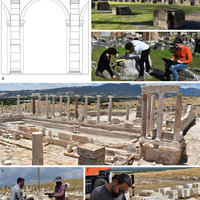 Rome, Basilica Iulia: hypothetical reconstruction of the first order of the façade (a, after Galli, Ismaelli 2022, fig. 1.107); the central aisle with cruciform pillars (b); cataloging of the blocks (c). Tripolis, Nymphaeum: general view of the building (d); handling of the blocks with a crane for survey and study (e); manual drawing of the blocks (f).
 -
 The ideal setting for block scanning: Tripolis, in the archaeological depot (a), on the field in a very broad shadow (b) or using a 2×2×2 m gazebo (c) with a black cloth (d), which provides a sufficient workspace to the operator (e); Basilica Iulia, on the field with a black cloth held and maneuvered by assistants (f)
 -
 Scanning a composite column capital (Tripolis, block no. Tr19AÇ101) using the ‘Distance meter’ histogram and the ‘Distance color’ tools (a); list of scans in an Artec Studio project after HD scan reconstruction and organization into groups (b). Cleaning process of the scans: manually erasing the captured ground under an immovable shaft of a pillar with half-column and pilaster (Basilica Iulia, no. 408964) using the ‘Lasso selection’ (c); manually erasing the ground and wooden blocks under an Ionic half-column capital (Tripolis, no. Tr23AÇ35) using the ‘Lasso selection’ (d); automatically removing with the ‘Base selection’ the table surface on which a pseudo-Corinthian pilaster capital (Tripolis, no. Tr15HCDP65) was resting during scanning (e)
 -
 Tripolis, Nymphaeum: alignment procedure in ‘Best Fit’ mode with manual selection of points of the SD (a) and HD (b) scans of the same Corinthian pilaster capital (no. Tr18AÇ20)
 -
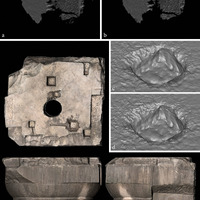 Rome, Basilica Iulia: a scan of the pillar shaft no. 409023 in the HD (a) and SD (b) versions, and two close-ups of the dowel hollow on the upper face from the HD (d) and SD (c) meshes. The Doric capital of pillar with half-column no. 408965: orthographic views of the front, the left and upper faces of the textured 3D model (e)
 -
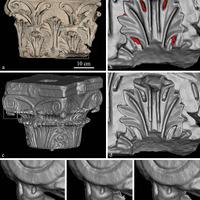 Tripolis, Nymphaeum: the Corinthian pilaster capital no. Tr18AÇ20, front face of the textured 3D model derived from HD scans (a); detail of an acanthus leaf of the mesh based on SD scans, during cleaning of the eyelets with the ‘Eraser’ tool (b), and the same leaf in the mesh from HD scans, without artifacts (d). Corinthian column capital no. Tr18AÇ300, non-textured 3D model derived from HD scans (c); detail of the pendulous top-leaflet of a corner acanthus leaf: ‘Sharp fusion’ from HD scans (e), ‘Sharp fusion’ from SD scans (f), and ‘Sharp fusion’ from SD scans cleaned with ‘Outlier removal’ (g)
 -
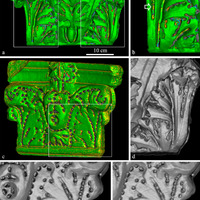 Tripolis, Nymphaeum: Corinthian pilaster capital no. Tr18AÇ21, ‘Smart fusion’ performed with maximum ‘Sharpness’ and ‘Sharp fusion’ (both SD) are overlaid and compared using the ‘Distance map’ tool in Artec Studio. The tool visualizes negative distances (blue) and positive distances (red) between two models, while green indicates distances close to zero, based on the set search distance – in this case 1 mm (a). A detailed view of the same ‘Distance map’: a fine-toothed acanthus leaf shows greater distances at the bottom of the longitudinal grooves and artifacts along the edges (b). A detail of another leaf (‘Smart fusion’) also shows numerous artifacts (d). The pseudo-Corinthian pilaster capital no. Tr21AÇ03, with unfinished acanthus leaves, is also displayed using the ‘Distance map’ visualization (c). A close-up of a leaf with the series of drill holes along its edges shows no artifacts in the HD mesh (e) and numerous artifacts in the SD one (f).
 -
 Tripolis, Nymphaeum: figured pseudo-Corinthian pilaster capital no. Tr18AÇMr32, textured HD model (a); comparison of the geometric detail definition between the untextured HD mesh (‘Sharp fusion’ at 0.5 mm resolution, b) and the SD mesh (same settings, c)
 -
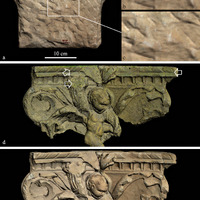 Tripolis, Nymphaeum: pseudo-Corinthian pilaster capital no. Tr22TtyMr08, textured SD model, rear face worked with a pointed chisel (a); detail of the texture generated without (b) and with (c) the ‘Glare reduction’ option. Figured pseudo-Corinthian pilaster capital no. Tr16AÇ104: HD scans showing green color interference caused by the table on which the block rests (see the table in Fig. 2, a) (d); 3D model textured with the ‘Glare reduction’ and ‘Background colors suppression’ options enabled (e)
 -
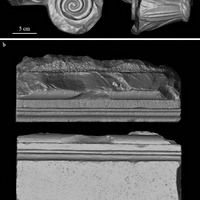 Tripolis, Nymphaeum: Ionic capital no. Tr23AÇ35, orthographic view of the front and left faces of the HD mesh (a). Rome, Basilica Iulia: cornice no. 409198, orthographic view of the front and bottom faces of the HD mesh (b).
Position: 135 (138 views)