

CQArchaeo: a Python package for Cosine Quantogram Analysis and Monte Carlo simulations
- Title
- CQArchaeo: a Python package for Cosine Quantogram Analysis and Monte Carlo simulations
- Creator(s)
- Giancarlo LagoSee all items with this value
- Lorenzo CardarelliSee all items with this value
- Nicola IalongoSee all items with this value
- Date
- 2024
- Is Part Of
-
 Archeologia e Calcolatori
- Volume
- 35
- Issue
- 1
- Pages
- 215–232
- Language
- eng
- Rights
- CC BY-NC-ND 4.0
- Abstract
- Cosine Quantogram Analysis (CQA) is a statistical analysis employed in archaeology for the study of numerical datasets with hypothesized quantal distribution. To verify thesignificance of the results, the analysis is often combined with the execution of Monte Carlo simulations. In this article, we present a freely downloadable Python package (CQArchaeo) that integrates CQA and Monte Carlo simulations in the same environment, making the analysis customizable in the main parameters. We provide a guide that enables the use of this tool even for researchers with limited experience in Python programming and demonstrate the applicability, functioning, and main limitations of the analysis on some archaeological datasets.
- Zotero References Collection
- https://www.zotero.org/groups/5293298/bidiar/collections/ZVD4U8FZ
- Cites
- Ayia Irini: The balance weights : an analysis of weight measurement in prehistoric Crete and the Cycladic Islands
- Weights and Weighing in Bronze Age Central Europe
- The earliest balance weights in the West: Towards an independent metrology for Bronze age Europe
- Money axes from Ecuador
- Weight regulation in British and Irish Bronze Age gold objects: a reanalysis and reinterpretation
- Weighing in Mesopotamia: The Balance Pan Weights from Ur
- Little Minions in Archaeology An open space for RSE software and small scripts in digital archaeology
- Lost in combat? A scrap metal find from the Bronze Age battlefield site at Tollense
- Scales, weights and weight-regulated artefacts in Middle and Late Bronze Age Britain
- The concept of weighing during the Bronze Age in the Aegean, the Near East and Europe
- De Poids et de Mesure. Les instruments de pesée en Europe occidentale durant les âges des Métaux (XIVe-IIIe s. a.C.). Conception, usages et utilisateurs
- Aegean Bronze Age Weights, Chaînes Opératoires and the Detecting of Patterns through Statistical Analyses
- Money or ingots? Metrological research on pre-contact Ecuadorian “axe-monies”
- Breaking down the bullion. The compliance of bullion-currencies with official weight-systems in a case-study from the ancient Near East
- Breaking sickles for shaping money. Testing the accuracy of weight-based fragmentation
- Hunting quanta
- A small change revolution. Weight systems and the emergence of the first Pan-European money
- Bronze Age weight systems as a measure of market integration in Western Eurasia
Linked resources
Export
- Media
-
 Fragmented, semi-finished and complete bronze objects from Late Bronze age battlefield of Tollense Valley (photo V. Minkus; courtesy of T. Terberger) (from Uhlig et al. 2019)
 -
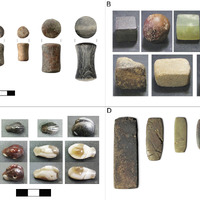 Examples of Western Eurasian balance weights of the Bronze age: A) spool-shaped weights from Tiryns, Greece (photo L. Rahmstorf); B) cubic weights from Dholavira, India (photo E. Ascalone); C) duck-shaped weights from Susa, Iran (photo E. Ascalone); D) parallelepiped weights from Lipari, Italy (photo N. Ialongo) (from Ialongo et al. 2021)
 -
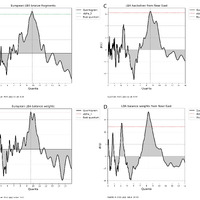 CQA and Monte Carlo simulations of weight (in grams): A) European Late Bronze age bronze fragments; B) European Bronze age balance weights; C) Late Bronze age hacksilver from Near East; D) Late Bronze age balance weights from Near East. Range (7-200 gr). Range of quanta (A-B: 4-16; C-D: 2-14). Step: 0.02
 -
 CQA and Monte Carlo simulations of weight (in grams): A) random numbers with uniform distribution; B) numbers with log-normal distribution; C) Ecuadorian axe-monies. Range (A-B: 7-200; C: 3-30). Range of quanta (A-B: 4-16; C: 1-8). Step: 0.02
 -
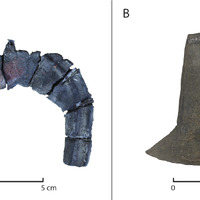 A) Replica of a bronze sickle broken during an experiment of weight-regulated fragmentation (from Lago et al. 2023); B) specimen of Ecuadorian ‘axe-money’ in arsenical copper alloy (AD 600-1532) from the Pre-Columbian Art Museum House, Quito (from Montalvo-Puente et al. 2023)
 -
 CQA and Monte Carlo simulations of weight (in grams): Quantogram 0. Bronze fragments from experimental weight-regulated fragmentation; Quantogram 1. Subsampling of archaeological fragmented sickles from European Bronze age hoards (n=117). Range (7-200). Range of quanta (4-16). Step: 0.02
 -
 CQA and Monte Carlo simulations of weight (in grams): A) British gold objects from the Bronze age – light range; B) British gold objects from the Bronze age – Heavy range. Range (A: 1-60; B: 60-410). Range of quanta (A: 2-50; B: 10-100). Step (A: 0.1; B: 1)
 -
 CQA and Monte Carlo simulations of weight (in grams): A) European Late Bronze age bronze fragments; B) sub-sampling (n=1,197) of European Late Bronze age bronze fragments; C) sub-sampling (n=997) of European Late Bronze age bronze fragments; D) sub-sampling (n=800) of European Late Bronze age bronze fragments; E) sub-sampling (n=600) of European Late Bronze age bronze fragments; F) sub-sampling (n=400) of European Late Bronze age bronze fragments. Range (7-200). Range of quanta (4-16). Step: 0.02.
Position: 3821 (31 views)