

Metodologie a supporto ricerca storico-archivistica e per la trasparenza del modello HBIM del Lazzaretto di Ancona nel progetto di Luigi Vanvitelli
- Title
- Metodologie a supporto ricerca storico-archivistica e per la trasparenza del modello HBIM del Lazzaretto di Ancona nel progetto di Luigi Vanvitelli
- Creator(s)
- Raissa MammoliSee all items with this value
- Marina InìSee all items with this value
- Ramona QuattriniSee all items with this value
- Date
- 2022
- Is Part Of
-
 Archeologia e Calcolatori
- Volume
- 33
- Issue
- 1
- Pages
- 157-178
- Language
- ita
- Rights
- CC BY-NC-ND 4.0
- Abstract
- In the Cultural Heritage domain, the potential of BIM for the built heritage is well known. However, research in Historical Building Information Modeling (HBIM) is still developing and deserves new experiments. Currently, the main objectives are the model transparency, meaning that sources and reliability of information can be linked to the model and retrieved from it, for a better interoperability and multi-disciplinary collaboration. Given the proliferation of 3D models, both informed and uninformed, and their increasing quality, there is a need to protect this heritage and provide useful uses beyond visualisation. This research not only addresses the challenge of creating an informed three-dimensional model capable of showing and documenting the evolution and transformation of the building, but also aims to achieve an output that can be used by historical experts who contribute to the creation and validation of the information apparatus. The case study is the Lazzaretto in Ancona, designed by Luigi Vanvitelli in the 18th century: it is an example of a building that shows the material culture of its time. The information gained from the primary sources, which contribute to the analysis of early modern notions of contagion, are merged with the analysis of the built environment. The proposed HBIM model is the result of interdisciplinary research between history and digital survey/representation and aims to provide the greatest transparency of knowledge in both areas. The informed model shows how the data improvement through HBIM platforms is a powerful tool to support historical-archival research and guarantees the transparency of the model.
- Zotero References Collection
- https://www.zotero.org/groups/5293298/bidiar/collections/HC9YJMQZ
- Cites
- BIM semantic-enrichment for built heritage representation
- ArchaeoBIM. Theory, processes and digital methodologies for the lost heritage
- Domestic buildings: Understanding houses and society
- Digital invasions: from point clouds to historical building object modeling (h-bom) of a unesco whl site
- Conservation-oriented hbim. the bimexplorer web tool
- B(H)IM -Built Heritage Information Modelling. Extending BIM approach to historical and archaeological heritage representation
- Gli Ordini Classici In Architettura. I fondamenti storici, gli ordini nei loro particolari, l’uso degli ordini
- The Yellow Flag: Quarantine and the British Mediterranean World, 1780–1860
- Computational Design for As-Built Modeling of Architectural Heritage in HBIM processes
- Building Information Modeling (BIM) for existing buildings — Literature review and future needs
- Materiality, Quarantine and Contagion in the Early Modern Mediterranean
- Virtual Restoration and Virtual Reconstruction in Cultural Heritage: Terminology, Methodologies, Visual Representation Techniques and Cognitive Models
- At Home and in the Workplace: A Historical Introduction to the "Spatial Turn"
- Modelling and Visualization Issues in the Architectural Heritage BIM
- BIM-Oriented Modelling and Management of Structured Information for Cultural Heritage
- La gelosa materia. I provvisori alla sanità di Ancona (1430-1810)
- Le magistrature giudiziarie di Ancona nei documenti comunali di antico regime (1308-1797)
- Fighting the Plague in Seventeenth-Century Italy
- Il Lazzaretto di Ancona un'opera dimenticata
- La centralità della rappresentazione con il BIM
- Transformation of Tools and Conservation of Architecture: Some Researches on the Use of Digital Systems for the Intervention on the Historical Buildings
- A Review of Heritage Building Information Modeling (H-BIM)
- L’inventario Angelini Rota dell’Archivio storico comunale di Ancona
- Modeling the Fourth Dimension of Architectural Heritage: Enabling Processes for a Sustainable Conservation
- Oriental plague” or epidemiological orientalism? Revisiting the plague episteme of the early modern Mediterranean
- The seeds of disease: An explanation of contagion and infection from the Greeks to the Renaissance
- A Semantic Web Approach for Built Heritage Representation
- The role of BIM (Building Information Modeling) for representation and managing of built and historic artifacts
- Firenze scomparsa: le chiese di Santa Chiara e San Pier Maggiore e la loro ricostruzione digitale presso i musei di Londra
- A Short Discourse Concerning Pestilential Contagion, and the Methods to Be Used to Prevent It
- Historic building information modelling (HBIM)
- Del governo della peste, e delle maniere di guardarsene, trattato di Lodovico Antonio Muratori ... diviso in politico, medico, et ecclesiastico
- A treatise of the plague: Containing an historical journal, and medical account, of the plague, at Aleppo, in the years 1760, 1761, and 1762
- Digital Transformation of the Design, Construction and Management Processes of the Built Environment (Open Access Book)
- Healthy Living in Late Renaissance Italy
- A 3D environment to rebuild virtually the so-called Augusteum in Herculaneum
- Paradata and Transparency in Virtual Heritage
- 3D Modelling and Visualization in Field Archaeology. From Survey To Interpretation Of The Past Using Digital Technologies
- Archaeological Building Information Modeling: beyond scalable representation of architecture and archaeology
- ArchaeoBIM: dallo scavo al Building Information Modeling di una struttura sepolta. Il caso del tempio tuscanico di Uni a Marzabotto
- From TLS to HBIM. High quality semantically-aware 3d modeling of complex architecture
- HBIM data management in historical and archaeological buildings
- An Introduction to the London Charter
- La regola dei cinque ordini dell'architettura
Export
- Media
-
 Vista della Mole Vanvitelliana dal Belvedere di Piazza San Gallo (Foto R. Mammoli, marzo 2019).
 -
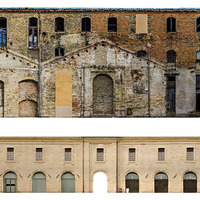 In alto: Ortofoto del prospetto SE, lato interno del Lazzaretto. Sulla facciata sono identificabili chiaramente le tracce di una delle fasi storiche: la manifattura tabacchi. I segni presenti sulle murature indicano lo spazio che, dal 1947 al 1997, è stato occupato dai magazzini.
 -
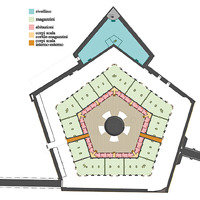 Pianta del Lazzaretto: distribuzione funzionale.
 -
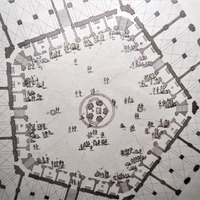 Dettaglio della pianta del Lazzaretto in Ancona, Museo della Città, Ancona, 1763-1764.
 -
 Luigi Pallavicini, dettaglio di un affresco raffigurante il cortile del Lazzaretto nel Palazzo Benincasa, Ancona, 1788.
 -
 Cyclone, nuvola di punti del cortile interno della Mole e Tempio di San Rocco.
 -
 https://www.archcalc.cnr.it/resources/images/433
 -
 Revit, vista del cortile interno del Lazzaretto e Tempietto di San Rocco secondo le due fasi di modellazione: XVIII secolo e XXI secolo.
 -
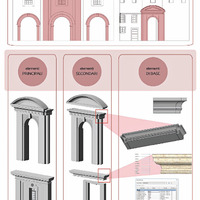 Suddivisione semantica del sintagma arco-trabeazione che costituisce rispettivamente le facciate esterne e interne rispetto al cortile centrale. Sono stati individuati gli elementi principali poi scomposti in quelli secondari e in quelli di base. Di quest’ultimi, rappresentati nella colonna di destra, viene illustrata la parametrizzazione.
 -
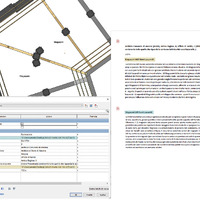 Revit, data enrichment: i vani identificati come magazzini sono stati implementati con parametri di progetto che raccolgono le informazioni archivistiche secondo lo standard ISAD. I documenti .pdf sulla destra sono i collegamenti diretti alle trascrizioni.individuati gli elementi principali poi scomposti in quelli secondari e in quelli di base. Di quest’ultimi, rappresentati nella colonna di destra, viene illustrata la parametrizzazione.
 -
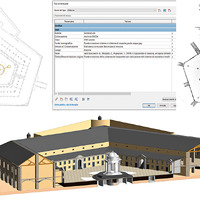 Revit, data enrichment per le cisterne.
Position: 3016 (34 views)