

Scansioni 3D di piccoli reperti per il progetto ArCOA (Archivi e Collezioni dell’Oriente Antico)
- Title
- Scansioni 3D di piccoli reperti per il progetto ArCOA (Archivi e Collezioni dell’Oriente Antico)
- Creator(s)
- Daniele BursichSee all items with this value
- Date
- 2024
- Is Part Of
-
 Archeologia e Calcolatori
- Volume
- 35
- Issue
- 2
- Pages
- 235-244
- Language
- ita
- Rights
- CC BY-NC-ND 4.0
- Abstract
- ArCOA is a project aimed at the study, enhancement and communication of museum collections and historical archives on the ancient Near East in Italy. ArCOA was born from the collaboration between the University of Milan and the Institute of Heritage Science of the National Research Council, with a multidisciplinary working group of archaeologists, assyriologists, museum curators, cultural mediators and experts of technology applied to cultural heritage. The ArCOA team collaborates with several museums, public institutions and universities, including the Archaeological Museum of Como, the National Archaeological Museum of Florence, the Department of Historical Studies of the University of Turin and the Museum of Antiquities of the Royal Museums of Turin, for the diffusion of knowledge of the ancient cultures of the Near East. This paper shows the results obtained on photogrammetric scans of small terracotta head and its reprocessing through different programs, its morphological and geometric rendering. Even if today open source photogrammetric programs seem to be almost absent from academic researchs because non-commercial alternatives are not very competitive, much is moving instead in the freeware direction, with regulated conditions of use for universities and research centres, such as for example the latest version of Reality Capture or Metashape. Furthermore, the acquisition processes vary greatly in relation to the size of the object, which can force the operator to think in terms of micro-surveys.
- Zotero References Collection
- https://www.zotero.org/groups/5293298/bidiar/collections/Q9DQHVDC
- Cites
- New perspectives on documenting Attic pottery
- Reflection transformation imaging and virtual representations of coins from the hospice of the grand St. Bernard
- Computer Vision: Algorithms and Applications
- Drones in Archaeology. State-of-the-art and Future Perspectives
- Virtual reconstruction of archaeological heritage using a combination of photogrammetric techniques: Huaca Arco Iris, Chan Chan, Peru
- 3D survey and virtual reconstruction of archeological sites
- A high-precision photogrammetric recording system for small artifacts
- Initial assessment on the use of state-of-the-art nerf neural network 3d reconstruction for heritage documentation
- NeRF: Representing Scenes as Neural Radiance Fields for View Synthesis
- 3D Gaussian Splatting for Real-Time Radiance Field Rendering
- Coroplastica di provenienza siriana e libanese in musei lombardi
- A comparison between 3d reconstruction using nerf neural networks and mvs algorithms on cultural heritage images
- Neural radiance fields (nerf): review and potential applications to digital cultural heritage
- Simulation of wrinkled surfaces
Export
- Media
-
 In alto: il sito web https://www.arcoa.it; nel mezzo: a sinistra, la figurina fittile A.1988.041(3) e a destra, il database creato dal CNR (https://arcoa.cnr.it/login); sotto: a sinistra, il procedimento di acquisizione RTI, a destra, momenti di lavoro con il set lightbox, luci e pedana rotante.
 -
 Flusso di lavoro con il software Metashape; in basso, il dettaglio dei supporti
 -
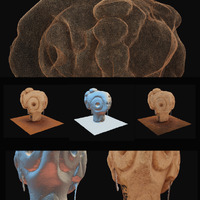 Flusso di lavoro con il software RealityCapture, in alto, la nuvola di punti; nel mezzo, i risultati dell’elaborazione (mesh con texture, mesh, point cloud); in basso, il dettaglio della testa con e senza texture
 -
 In alto: flusso di lavoro con il software Zephyr, il dettaglio della testa con e senza texture. Nel mezzo e in basso: flusso di lavoro con il software Cloud Compare, comparazione delle mesh da Zephyr (verde) e Metashape (grigio)
Position: 6193 (26 views)