

Geostatistical mapping of pottery variation: the northern lands of western Asia during the Middle Bronze Age
- Title
- Geostatistical mapping of pottery variation: the northern lands of western Asia during the Middle Bronze Age
- Date
- 2024
- Is Part Of
-
 Archeologia e Calcolatori
- Volume
- 35
- Issue
- 2
- Pages
- 371-380
- Language
- eng
- Rights
- CC BY-NC-ND 4.0
- Abstract
- This paper challenges conventional mapping methods of Bronze Age ceramic variation in western Asian archaeology, which often oversimplify the complexity of cultural phenomena. Drawing on geostatistical techniques, we propose a novel approach that considers both similarities and differences in ceramic traits. By incorporating Principal Coordinate Analysis (PCoA) and kriging interpolation techniques, our methodology aims to provide a nuanced representation of pottery distribution, moving beyond static cultural-historical mapping. We argue that this approach offers a more comprehensive understanding of archaeological landscapes by acknowledging the diversity of pottery variation. Through a case study utilising legacy pottery data – which will be published in the future according to the FAIR principles – we demonstrate the practical application and potential insights of our methodology, which seeks to advance archaeological methods and contribute to a richer interpretation of the past.
- Zotero References Collection
- https://www.zotero.org/groups/5293298/bidiar/collections/63V6GKJD
- Cites
- Vision, perception and GIS: developing enriched approaches to the study of archaeological visibility
- Quantifying archaeology
- The FAIR Guiding Principles for scientific data management and stewardship
- Analysing Ecological Data
- Spatial Pattern and Environmental Correlates of a Midwestern Stream Fish Community: Including Spatial Autocorrelation as a Factor in Community Analyses
- Culture History: A Culture- Historical Approach
- The Archaeology of the Caucasus: From Earliest Settlements to the Iron Age
- Anatolia and the Transcaucasus Themes and Variations ca. 6400–1500 B.C.E.
- R: The R Project for Statistical Computing
- Distribution and Chronology of the Nineveh 5 Pottery and of its Culture
- ape 5.0: an environment for modern phylogenetics and evolutionary analyses in R
- The Red and the Black. Social and Cultural Interaction between the Upper Euphrates and the Southern Caucasus Communities in the fourth and third Millennium BC.
- Doğu Anadolu Yayla Kültürleri (M.Ö. II. Binyıl)
- Isolation-by-distance, homophily, and “core” vs. “package” cultural evolution models in Neolithic Europe
- Pots and People
- Archaeological Theory: An Introduction
- Some Distance Properties of Latent Root and Vector Methods Used in Multivariate Analysis on JSTOR
- Biogeographical patterns in vertebrate assemblages of the Czech Republic: regional division in the context of species' distributions in Europe
- Change and Archaeology
- The Danube in Prehistory
- Doğu Anadolu Arkeolojisinde Göçebelik ve Yaylacılık Kültürü (MÖ II. Bin): Veriler Işığında Yeni Düşünceler
- Greeks, Barbarians and Archaeologists
- Archaeology and Cartography: In Search of the Prehistoric Cultures in the Neolithic Near East
- The map as assemblage: Landscape archaeology and mapwork
- ArcGIS Desktop
- Spatial studies in archaeology
Export
- Media
-
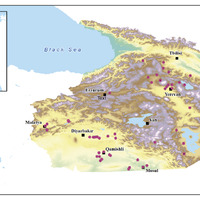 The Northern Lands of western Asia with the sites (in pink) used for analysis
 -
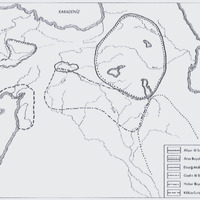 Ceramic cultures in the Northern Lands during the Middle Bronze Age (modified from Özfirat 2001, fig. 1)
 -
 Sample of decorative traits analysed in this paper
 -
 Snapshots of the dataset organisation: a) site information and b) presence-absence matrix (PAM)
 -
 Snapshot of the Jaccard dissimilarity matrix
 -
 Plots showing the results of the first three PCoA axes
 -
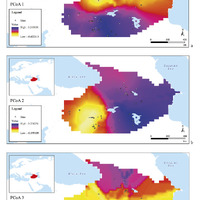 Interpolated maps using Ordinary Kriging showing the geographic representation of the first three PCoA axes. Similar colours describe similar values in cultural variation
Position: 3490 (32 views)